

Active Play for Children: Why Movement Matters for Learning
Children rarely separate moving, playing and learning in the way adults do.

A walk can become a treasure hunt. A scooter ride can turn into a game of spotting colours. A trip to the park can involve counting, balancing, problem-solving, storytelling and exploring, often without children realising they are learning at all.
That is the beauty of active play.
Active play gives children opportunities to move their bodies while exploring the world around them. And it doesn't need to involve organised sport, complicated activities or an afternoon's worth of preparation.
Sometimes, all you need is a little space, a simple idea and permission to play.
What is active play?
Active play is any form of play that gets children moving.
For younger children, that might mean crawling, reaching, dancing, climbing or chasing bubbles. As children get older, it can include running, jumping, balancing, scooting, cycling, playing games or exploring outdoors.
But movement is only part of the picture.
Good active play can encourage children to make decisions, solve problems, communicate, use their imagination and develop confidence.
It's a simple example of learning through play, where children develop skills through experiences that feel fun rather than formal.
Why is active play important for children's development?
Physical activity naturally gives children opportunities to practise skills such as balance, coordination and body control.
But active play can support much more than physical development.
Think about a child following a simple obstacle course. They need to listen to instructions, remember what comes next, judge distances and work out how to move around each obstacle.
Or consider a child scooting to the park. They're navigating their surroundings, making decisions, developing balance and coordination and responding to what's happening around them.
Add a simple game along the way, and you can bring even more learning into the adventure.
· How many red things can you spot?
· Can you find something beginning with S?
· Which way should we turn to get home?
Suddenly, getting from A to B becomes an opportunity to move, think, and explore.
Learning doesn't have to happen sitting down.
When we think about children's learning, it's easy to picture books, pencils, puzzles and activities around a table.
But children can learn while they're moving too.
Busy Brains Activity Packs are designed around the idea that purposeful play can support different areas of a child's development. Activities can encourage skills across areas including communication and language, physical development, creativity, early problem-solving, literacy, mathematics and understanding the world.
Movement can become part of that same approach.
Try combining active play with simple learning prompts:
Numbers: Count jumps, steps, scooter pushes or trees.
Colours: Find five different colours while you're outside.
Language: Choose a letter and spot things beginning with it.
Memory: Create three actions and see if your child can remember the sequence.
Problem-solving: Build an obstacle course and ask your child to find different ways through it.
Imagination: Turn a walk or scoot into a jungle expedition, dinosaur hunt or mission to the moon.
The activity doesn't have to feel educational to your child. In fact, that's rather the point.
They're simply playing.
7 easy active play ideas for children
Active play doesn't require lots of equipment or planning. Start with what you already have and where you already go.
1. Create a garden obstacle course

Use cushions, chalk, plant pots, hoops or anything else safe that you have available.
Give children different instructions: jump over, weave around, crawl under or balance along.
For older children, let them design the course themselves. Deciding where things go and how someone should complete the course adds another layer of problem-solving and creativity.
2. Go on a Scoot & Seek adventure
Turn a children's scooter ride into an active play adventure by adding a simple spotting challenge.
Can you find:
· Something red
· A number bigger than 20
· A bird
· Three different types of leaves
· Something beginning with M
· Something circular
Change the list each time and suddenly a familiar route becomes a new adventure.
For younger children, keep the challenges visual and simple. Older children can tackle harder clues, spellings, sums or even create the next Scoot & Seek list themselves.
3. Play movement maths
Practise simple maths while moving.
“Do five jumps.”
“Take three big steps and two little steps. How many steps did you take altogether?”
“Can you scoot to the third tree?”
For younger children, simply counting movements aloud introduces numbers naturally through play. As their confidence grows, you can make the challenges more complicated.
4. Follow the leader
One person chooses how everyone moves: hopping, skipping, marching, scooting slowly or taking giant steps.
Swap leaders regularly so children can invent their own movements and give instructions.
It can be surprisingly good fun when children get to tell the grown-ups what to do for a change.
5. Make your journey the activity
You don't necessarily need to find extra time for active play.
Look at journeys you're already making.
Could you walk or scoot part of the school or nursery run? Could the journey to the park include a scavenger hunt? Could a trip to the shops become a game of spotting shapes, letters or numbers?
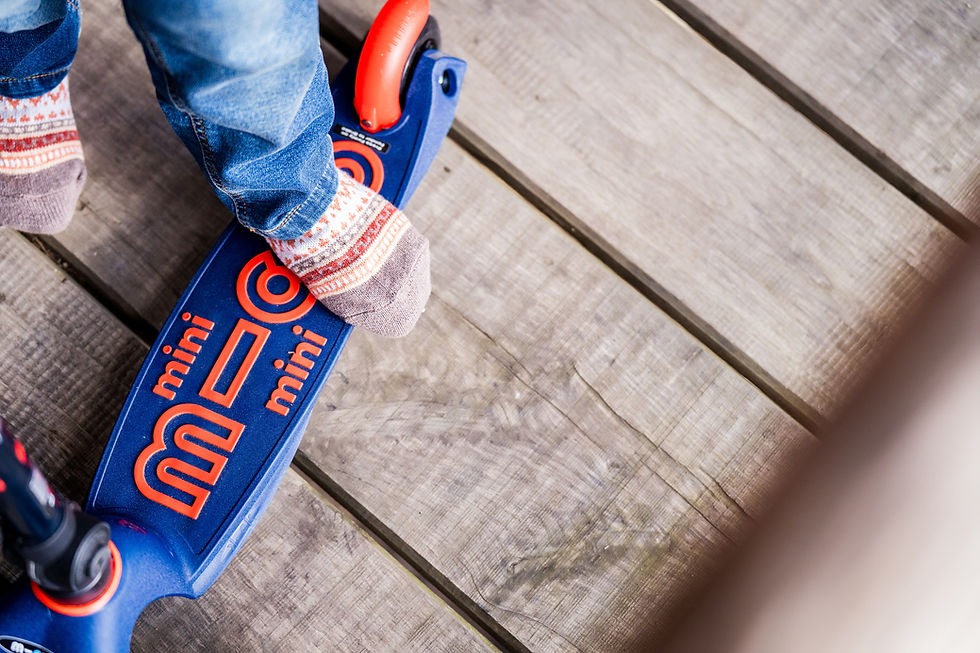
For younger children, choosing an age-appropriate toddler scooter that they can comfortably control can help make active journeys feel more manageable and enjoyable.
Building play into an existing routine often makes it much easier to do regularly.
6. Try an outdoor listening game
Stop somewhere safe and quiet and listen.
How many different sounds can your child identify?
You might hear birds, footsteps, traffic, leaves, dogs or an aeroplane overhead.
It's a wonderfully simple way to combine an active trip outside with communication, concentration and awareness of the world around them.
You can take the idea further by asking children to describe whether each sound is loud or quiet, near or far, natural or human.
7. Let children invent the game
Not every activity needs instructions.
Give children a few simple objects or a destination and ask:
“What could we do with these?”
They might create a race, obstacle course, imaginary world or entirely new game with rules that make absolutely no sense to anyone over the age of six. That's fine. Creating the game is part of the play.
Active play doesn't have to be another job for parents
Perhaps the most important thing to remember is that active play doesn't need to become another item on the family to-do list.
You don't need elaborate equipment. You don't need to create a picture-perfect activity. And you certainly don't need to entertain your child every minute of the day.
Busy Brains Activity Packs were created to make purposeful play easier for families, with activity ideas and resources designed to fit into everyday family life.
Micro Scooters shares a similar belief when it comes to getting children moving: sometimes the easiest way to encourage activity is to make movement something children genuinely want to do.
The sweet spot is simple, enjoyable and repeatable.
From busy brains to busy bodies
Children are naturally curious about the world.
Give them opportunities to move through it, explore it, question it and play in it, and one simple activity can support lots of different skills at once.
So next time you're looking for something to do, you don't necessarily need a complicated plan.
Pick an activity. Grab the scooter. Head outside. Make up a challenge.
Then see where their busy brains and busy bodies take you.
FAQs about active play for children
What is active play for children?
Active play is play that involves physical movement. Depending on a child's age, this could include crawling, dancing, running, jumping, climbing, balancing, scooting or playing movement-based games.
Why is active play important?
Active play gives children opportunities to develop physical skills such as balance, coordination and body control. Depending on the activity, it can also encourage communication, imagination, confidence, decision-making and problem-solving.
What are some examples of active play?
Simple examples include obstacle courses, treasure hunts, dancing, follow-the-leader games, nature walks, scooting, cycling, ball games and movement challenges.
How can I combine learning with physical activity?
Keep it simple. Count jumps, look for letters and numbers on a walk, practise colours during a scooter ride or create an obstacle course involving simple instructions. Children can practise different skills while still seeing the experience simply as play.
Does active play have to be outdoors?
No. Children can dance, play movement games, build indoor obstacle courses or practise balancing indoors where there is enough safe space. Outdoor play simply provides additional opportunities to explore the environment and move over greater distances.
How can busy families fit more active play into the day?
Build it around things you're already doing. Walk or scoot short journeys, add a spotting game to the school run, spend ten minutes playing outside after nursery or turn a trip to the park into a simple challenge.
Active play doesn't need to take up an entire afternoon.

Comments